
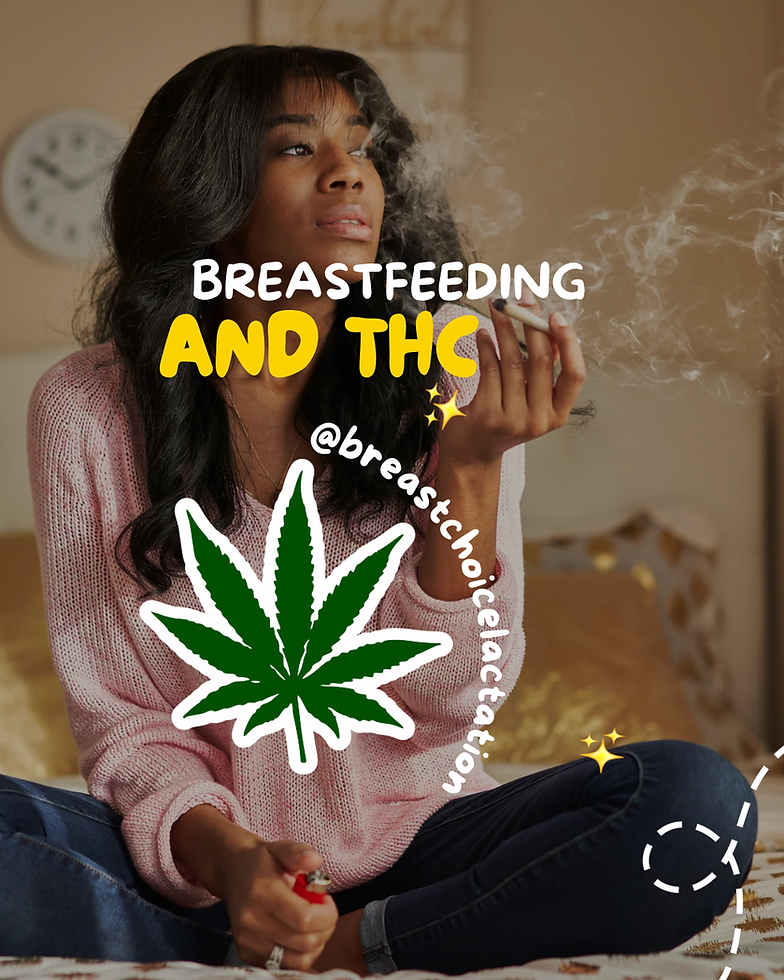
Breastfeeding and THC
- Apr 20
- 7 min read
THC and Breastfeeding: The Truth Nobody Told You
If you've ever Googled "weed and breastfeeding" at 2am while nursing a baby and trying to hold yourself together, this post is for you.
Not for the version of you that's supposed to have it all figured out. For the real you — the one managing anxiety, chronic pain, or just the relentless weight of postpartum life without nearly enough support.
No judgment here. Just the facts you deserve to have.
First, Let's Talk About Who's Actually Using Cannabis While Breastfeeding
Before we get into the science, let's clear something up: most breastfeeding moms using cannabis are not doing it to get high.
According to a 2022 study published in *Breastfeeding Medicine*, 89% of breastfeeding mothers using cannabis reported doing so to manage anxiety, depression, chronic pain, gastrointestinal symptoms, or PTSD. Only 54% reported using it to get high — and that was more common among frequent users.
That matters. Because the conversation around weed and breastfeeding has been dominated by shame and oversimplification, when the reality is that most moms are just trying to survive a postpartum period that doesn't offer them nearly enough real support.
Use of cannabis during pregnancy doubled between 2002 and 2017, rising from 3.4% to 7% among pregnant women nationally (Volkow et al., *JAMA*, 2019). During COVID, a Kaiser Permanente study of 100,000 pregnant women in California found use jumped another 25% — from 6.75% to 8.14%. And evidence shows that chronic use typically does not decrease once a mom is breastfeeding.
We are not talking about a rare or fringe situation. We are talking about a reality that deserves honest, compassionate information.
What Happens to THC in Breast Milk?
Here's what the research actually tells us.
THC is fat-soluble. That means it loves fat — and it binds to fat. Your body is about 25 to 30% fat. Breast milk is 3 to 5% fat (even higher in milk produced for premature babies). So when THC enters your system, it seeks out those fat stores — including the fat in your milk.
Research shows that milk levels of THC can run up to 8 times higher than levels in the mother's bloodstream (Perez-Reyes & Wall, *NEJM*, 1982). THC is absorbed by the baby and has been found in infant stool. It can be stored in the baby's fat tissue for months, and shows up in urine for 2 to 3 weeks after exposure.
What About Pump and Dump?
This is the big one. The myth that won't die.
Pumping and discarding your milk does not clear THC from your system. Because THC isn't just sitting in your milk waiting to be removed — it's stored in your body fat and continuously making its way into your milk as long as it's present in your system.
A landmark study published in *JAMA Pediatrics* in 2021 (Wymore et al.) found that THC persisted in breast milk for up to 45 days after last use. Not hours. Not days. Up to six weeks.
A blood test won't help either. Because THC concentrates in milk fat at levels much higher than the bloodstream, your blood level doesn't accurately reflect what's in your milk.
What Does the Research Rating System Say?
Lactation pharmacologist Dr. Thomas Hale's research places THC at:
- **L3** (Limited Data, Presumed Compatible) for infrequent use
- **L4** (Limited Data, Possibly Hazardous) for chronic use
For context L1= completely safe to L5=contraindicated
The relative infant dose of THC is approximately 2.5%, with a range of 0.4 to 8.7%. Daily infant intake was found to be minimal in his research — but the wide range matters, and the long retention in milk matters too.
The Real Risk Picture
This is where nuance becomes essential — because this is not a simple yes or no situation.
Yes, THC passes into breast milk and is absorbed by your baby. Research suggests it can affect brain development, cognitive function, and emotional regulation over time. Exposure to cannabis has also been associated with increased risk of Sudden Infant Death Syndrome.
And also:
Breastfeeding itself supports brain development and bonding. It protects babies from SIDS. The immunological, nutritional, and relational benefits of breastfeeding are well established and significant.
So the risk equation is not "cannabis vs. no cannabis." It's more like: risk of breastfeeding with some THC exposure vs. risk of not breastfeeding at all. Risk of untreated maternal anxiety, depression, and PTSD vs. risk of cannabis exposure. That's a complex, individual calculation — and it's one you deserve help thinking through, not one you should be shamed out of having.
The harm reduction framework that guides my practice says: some breastfeeding is better than none, and less cannabis is better than more. Any reduction matters.
What About CBD?
CBD deserves its own mention because it's often marketed as the "safe" alternative. The reality is more complicated.
Research shows CBD passes into breast milk at similar rates to blood levels. One study found THC present in 63% of breast milk samples, while CBD appeared in only 9% — but that doesn't mean CBD is without concern.
CBD products are poorly regulated. They can be contaminated with THC, pesticides, or fertilizers. Dispensary staff are not trained lactation advisors. And because CBD can contain trace THC even when labeled as THC-free, it can trigger a positive drug test — which can have serious consequences for moms in regulated professions like nursing, transportation, or healthcare.
More research is needed before CBD can be considered safe for breastfeeding.
Holistic Alternatives Worth Exploring
If you're using cannabis to manage anxiety, pain, sleep issues, or postpartum depletion, there are evidence-informed and traditional alternatives that may help — and that are compatible with breastfeeding when used appropriately.
Ashwagandha- is an adaptogen with growing evidence for supporting cortisol regulation and reducing anxiety. It may be beneficial for postpartum stress, though lactation-specific data is limited — use with provider guidance.
Blue Vervain- is a traditional nervine herb historically used for people who carry tension in their body and struggle to decompress. Often described as supportive for the wound-up, overwhelmed postpartum nervous system. Work with a trained herbalist.
Milky Oat Straw is a gentle nervine with a long history of use for nervous system depletion — exactly what the postpartum body often experiences. It also has a traditional reputation as a galactagogue, making it a double benefit for breastfeeding moms.
BrainTap is a neurostimulation and guided meditation technology that uses light and sound to help regulate the nervous system out of chronic fight-or-flight. No substances involved, and deeply restorative for moms whose nervous systems are running on empty.
Perinatal mental health support is frankly, the most important intervention of all. If anxiety, depression, PTSD, or chronic pain are driving cannabis use, you deserve access to a perinatal mental health specialist, a therapist who understands postpartum, or a supportive community of moms who actually get it. That support exists. You deserve it.
How to Have This Conversation With Your Provider
US health agencies, the American Academy of Pediatrics, and professional nursing and obstetric associations all advise breastfeeding mothers to abstain from cannabis and CBD. That is the official guidance, and it's worth knowing.
It's also worth knowing that real clinical practice looks different — because real patients are complex, and harm reduction is a valid, evidence-supported framework.
If you are using cannabis while breastfeeding, here is what I encourage:
- Be honest with your IBCLC and your healthcare provider. You cannot be well-supported if people don't know what's actually happening.
- Ask about help for what's underneath the use — nausea, anxiety, depression, pain, PTSD. There are treatment options, and you deserve access to them.
- If abstinence isn't currently possible, focus on reduction. Every reduction matters.
- Watch your baby — for excessive sleepiness, poor feeding, slow weight gain, or missing developmental milestones.
- Avoid smoke exposure. Keep baby away from smoke and smoky clothing.
- Never co-sleep when impaired.
A Note on Judgment
I want to be direct about this: the way our medical system has handled cannabis and breastfeeding has caused harm. Moms have been shamed, reported, and scared into silence — which means they've made decisions without information, and without support.
You came here looking for real answers. That is an act of love for your baby and for yourself.
At The Breast Choice, the whole mama matters. Not just the milk, not just the decision about cannabis — all of you. If you want to talk through your situation, explore your options, and make the decision that's right for your family with someone in your corner, that's exactly what I'm here for.
Sources
- Garner, C.D., Kendall-Tackett, K., Young, C., Baker, T., Hale, T.W. (2022). Mode of cannabis use and factors related to frequency of cannabis use among breastfeeding mothers. *Breastfeeding Medicine, 17*(3).
- Hale, T.W. (2019, 2022). Opioids and Cannabis in breastfeeding mothers. PowerPoint presentation.
- Moss, M.J., Bushlin, I., Kazmierczak, S. et al. (2021). Cannabis use and measurement of cannabinoids in plasma and breast milk of breastfeeding mothers. *Pediatric Research, 90*, 861–868.
- Perez-Reyes, M. & Wall, M.E. (1982). Presence of delta-9-tetrahydrocannabinol in human milk. *New England Journal of Medicine, 307*(13), 819–820.
- Volkow, N.D., Han, B., Compton, W.M., et al. (2019). Self-reported medical and nonmedical cannabis use among pregnant women in the United States. *JAMA, 322*(2), 167–169.
- Wymore, E.M., Palmer, C., Wang, G.S., et al. (2021). Persistence of Δ-9-Tetrahydrocannabinol in human breast milk. *JAMA Pediatrics, 175*(6), 632–634.
- Yeung, C.H.T., Bertrand, K.A., Best, B.M. et al. (2023). Cannabidiol exposure through maternal marijuana use: predictions in breastfed infants. *Clinical Pharmacokinetics, 62*, 1611–1619.
*This post is for educational purposes only and does not constitute medical advice. Please consult your healthcare provider for guidance specific to your situation.
*Ready to talk through your situation with an IBCLC who won't judge you? Book a consult at The Breast Choice.]*


Comments